Here’s a little trick I’ve used in D&D games where the premise of your campaign calls for the party to have access to lots of Stuff, but you don’t want to do a whole bunch of bookkeeping: the Wagon.
In a nutshell, the party has a horse-drawn wagon that they use to get around between – and often during – adventures. This doesn’t come out of any individual player character’s starting budget; it’s just provided as part of the campaign premise.
Before setting out from a town or other place of rest, the party has to decide how many gold pieces they want to spend on supplies. These funds aren’t spent on anything in particular, and form a running total that represents how much Stuff is in the wagon.
Any time a player character needs something in the way of supplies during a journey or adventure, one of two things can happen:
1. If it’s something that any fool would have packed for the trip and it’s something that could reasonably have been obtained at one of the party’s recent stopovers (e.g., rations, spare clothing, fifty feet of rope, etc.), then the wagon contains as much of it as they reasonably need. Just deduct the Player’s Handbook list price for the item(s) in question from the wagon’s total.
2. If it’s something where having packed it would take some explaining, or if it’s something that’s unlikely to have been available for purchase at any of the party’s recent stopovers (e.g., a telescope, a barrel of fine wine, a book of dwarven erotic poetry, etc.), the player in need makes a retroactive Intelligence or Wisdom check, versus a DC set by the GM, to see if they somehow anticipated the need for the item(s) in question. Proficiency may apply to this check, depending on what’s needed. The results are read as follows:
Success: You find what you’re looking for, more or less. If the group is amenable, you can narrate a brief flashback explaining the circumstances of its acquisition. Deduct its list price (or a price set by the GM, if it’s not on the list) from the wagon’s total.
Failure by 5 points or less: You find something sort of close to what you’re looking for. The GM decides exactly what; it won’t ever be useless for the purpose at hand, but depending on her current level of whimsy, it may simply be a lesser version of what you were looking for, or it may be something creatively off the mark. Deduct and optionally flash back as above.
Failure by more than 5 points: You come up empty-handed, and can’t try again for that item or anything closely resembling it until after your next stopover.
As an incidental benefit, all the junk the wagon is carrying acts as a sort of ablative armour. If the wagon or its horses would ever take damage, instead subtract a number of gold pieces from its total equal to the number of hit points of damage it would have suffered. The GM is encouraged to describe what’s been destroyed in lurid detail.
The villain is my favorite part of ANY campaign. So here I am gonna talk about how you can make different kinds of villains, honing down on a specific type and offering various ways to make them interesting. As always, we will be looking at real world history, culture, and mythology to make your villains seem realistic and specifically dastardly. For our first entry let’s discuss…
~~~~~~~~~~~~Archfey Villains~~~~~~~~~~~~
Why archfey? Two reasons: 1) I like archfey, they’re fuckin’ dicks. 2) Someone who’s name I can’t find asked me to make this and I am more than happy to make things for my followers.
NOW, let’s understand what an archfey really is.
An archfey is a creature of fey ancestry that is excessively powerful, nearing the power of a deity. Usually, such creatures are native to the Feywild. Within this realm, they command great power and can even shape the realm itself to their whim and whimsy.
Common Misconception
Archfey doesn’t mean “superelf.” An archfey can be a pixie, a dryad, a ghost, a beast of some kind, anything that is classified as “fae” or “fae-like” can be turned into an archfey. Elf-like archfey are the most COMMON, but absolutely not the ONLY form of an archfey.
The other misconception is that the archfey are good. This is because the Feywild is mistaken as a plain of good, while Shadowfell is a plain of evil. This is wrong. Feywild and Shadowfell aren’t images of good and evil. Their are images of abundance vs lack of emotion. Shadowfell is a plain of the depressed, the emotionless, the broken. Feywild is a plain of the bipolar, the expressive, the artists and the madmen.
(I’m getting tired of saying “archfey”)
Characteristics of the Archfey
So to understand how we get an Archfey villain, lets discuss some general characteristics of the archfey.
Background.
The archfey come from the Feywild. This is a place governed by emotion. When its denizens feel something strongly, they can physically change their environment. A cruel witch will transform the forest around her to grow trees that bleed and produce fruits shaped like heads. While a kind princess will transform the fields around her into a gorgeous plain of crystalline flowers.
Now, the archfey can transform the Feywild at a moment’s notice. Which means they can do one or both of these things:
They can control their emotions very well.
They only ever have emotional extremes powerful enough to instantly alter the Feywild.
Lifestyle
The archfey live careless lives. They are too powerful to have any natural predators, as such live carefree and happy. Due to their extended life (they live like thousands of years), they are NEVER in rush. Why should they be? They’ve got time, ALL the time.
Environment
Based on HOW the Feywild is, how it is ever-shifting and changing, its denizens must learn to control this change to be able to thrive. Since we are working with an archfey, we can assume they’ve already thrived to the top of their food chain. As such, they must have learned to command the Feywild OR adapted to this changing world, having very drastic changes in personality, behavior, or even looks.
With all this information, let’s share some ideas for archfey villains.
Examples of Archfey Villains
Example #1: The Many Faced Man. Simply put, a doppelganger. The archfey are ever-changing. For this example, our villain always changes their looks. So your Party pisses off this archfey or in some way becomes enemies with him. So when your spends the night camping outside, whoever is keeping watch suddenly poof, is teleported away (because this is an Archfey, it can do this kind of shiz) and in steps a the Many Faced Man who takes this lost PCs form.
I urge you, IRL, pull the Player of this character aside and tell them your plan. Tell them that you want to replace them with a Doppelganger, but not to worry, because their PC will eventually be rescued. THEN, offer them to role play as a doppelganger pretending to be their character. Most players will have TONS of fun with this idea. If you player doesn’t want to RP a doppelganger offer them to role a new temporary PC or just dump the idea.
Example #2: Prince of Liars. A very powerful archfey this one is. He has immense power in the Feywild, and has managed to TRAP the Party in his domain. I’m stealing from Curse of Strahd here, but essentially rework that campaign with more fey-like themes. Instead of vampires, we got fey, instead of Strahd we got a spoiled brat of a prince who is all-powerful but only wants to mess with the Party before killing them in a cruel manner for his or her amusement.
For additional complexity, you can make the Prince of Liars have very drastic shifts of emotion. Think, the bad guy from Split (the movie). One moment he is nice to the Party and leads them to a place filled with treasure, the next he snaps into sheer brutal cruelty and slaughters the ranger’s companion. This will put the Party on edge when dealing with the guy. Furthermore, knowing that the archfey is powerful enough to destroy them with ease puts the Party on the edge, at least until they find something that can kill or neutralize this big bad.
Example #3: The Undying Court. This is for LARGE scale campaigns. Let’s say you have a game that is heavy on politics, but spans different dimensions. So the PCs are working with the politics between Mount Celestia and the 9 Hells and the Abyss, etc. That’s when you throw in the Undying Court. A hive-mind of several Archfey that operate as a singular entity and wish to expand their chaotic influence across the many plains. They may ally with Demon Lords and expedite chaotic situations to gain more power, so your PCs would have to negotiate a turbulent field of politics.
And that’s that folks. I hope this provides SOME use to y’all and helps you out with future ideas. Of course you don’t HAVE to follow my guideline 100%. You don’t need to follow it at all, in fact. Just take it as it is, my ideas for a good fey villain. What about you folks? Would you like to see breakdowns of other kinds of villains? I’d love to do more. Send your recommendations my way or share your ideas for villains. I’d love to hear it. Good luck everyone.
So I tried a thing in D&D in the lead up to my next campaign. Not to blow my own horn, but I thought it was a neat idea and I really like that I did it. I haven’t seen it suggested before (not saying it hasn’t) and I just wanted to share an idea, in case it can inspire anyone.
If you do your own world building, it can be hard to get players to realise aspects of it, or you get the moments where they aren’t quite sure of events related to the world. This is why I decided to do four one shots that are set around the next setting. The players made characters that fit the theme of each one shot:an archaeological expedition sent by a university; some elite paladins sent to investigate a bunch of their church’s missionaries not returning; a coup enacted by hobgoblins to seize control of a city in the background; and evil pirates of the crew that ended up capturing them in their prologue sessions (though there were two spies also in there).
This helped hone in on different aspects of the world and the area that they would be in. I also threw in some cameo NPCs related to backstories or their prologue sessions, or even some that would be future NPCs potentially. And I think they really enjoyed it.
I enjoy the idea of world building through one shots. Sure you can tell the players of events through exposition, but they will probably remember more if you let them play as the characters involved in the event. It also allows you, as a DM, to experiment. In my one shots I got to try an evil story, a horror story, and one relying on stealth. Sometimes you can railroad a bit, if you have desired outcomes (and it becomes more of a “this is how this major event occurred) or you can have it completely free form and let their success OR failure impact that situation.
It also gave players a better look at their character’s backstory NPCs – one player saw her character’s father endure something tense and saw an added layer of guilt that might play into why he is how he is. Another thing you can do, if you copy my idea of letting them play as members of your villain’s crew or organisation, you can make them realise how detestable the villain(s) are, or even give them a more human side.
It could help enlighten you on motivations, locations, characters, and such.
tldr; doing world building one shots rather than explaining copious amounts of lore might be one of the most fun ideas that I have tried.
In the PHB, the Reincarnation spell only lists racial options that were given in the PHB, which makes sense. However, we have since gotten more playable races, so it’s high time to expand it. (This has probably been done already, but now it’s been done by me.)
I tried to give vaguely equal prominence to all races, while also including all subraces. This is mathematically impossible when dealing with one hundred integers, therefore you get this approximation. (Each result within “dragonborn” gives the option of two colours, to avoid being completely ridiculous.)
This includes all races and subraces from the PHB, Volo, Mordenkainen, and Elemental Evil.
After 2 years of D&D homebrew, I’ve decided to look back on some of the older designs I’ve made, and give them a few updates, either to get them a little more balanced, or simply to rehash them using the knowledge I’ve gleamed over the years to make them better. Ecunna was kind enough to give me a hand with this one, and it’s certainly turned out better than expected!
The Timekeeper was always intended as a creature that fought alongside time itself, and now it certainly feels more like what I intended it to be in the first place. Still as dangerous as ever, but now with a more snowball play style. Leave this thing long enough and it’ll be harder and harder to emerge victorious.
Every month, our Patrons send us four-word suggestions, and everyone can vote on them with a like. We pick the three most popular suggestions and turn them into mini designs, live on twitch!
Roll a d20 whenever the party goes anywhere.
1-4: Nothing
5-16: Make everyone roll perception, and if anyone makes it you describe the immediate vicinity in extreme detail for no reason
17-20: Everyone rolls perception, then one or more object in the room is a mimic.
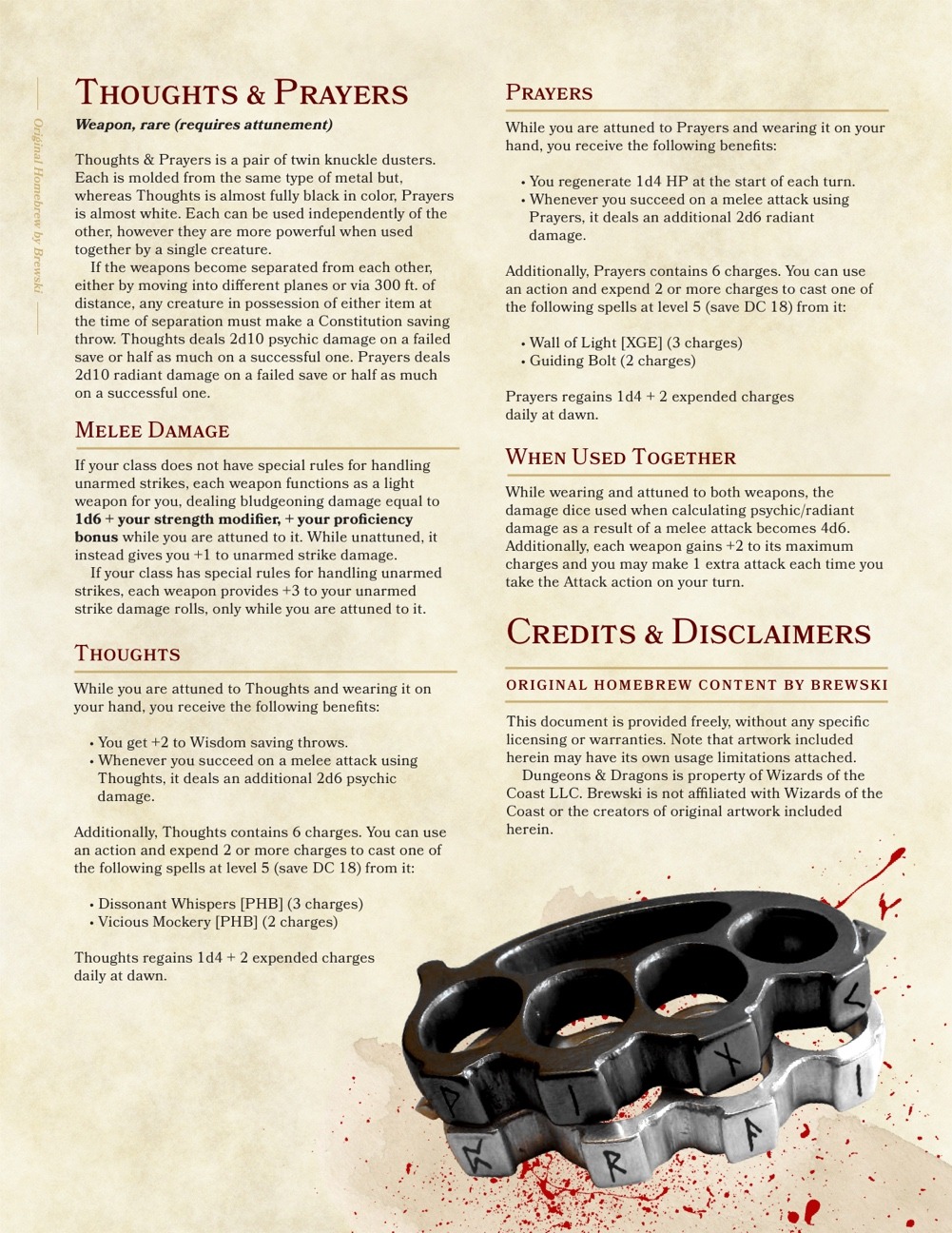
A lot of you have probably seen something like this before. If you google “dnd magic item”, one of the first things that shows up is a post by @sskyeh (original tweet here) that says…
“D&D item: twin brass knuckles named Thoughts & Prayers that deal psychic and radiant damage respectively”.
Well, people loved that idea and have made a few different versions:
If you consume this potion as an action, you immediately fall unconscious for 1 minute. After that time you gain the benefits of a short rest.
One dose of this is a little pint of 1 ounce. The potion is deep black and smells like coffee and lavender.
Cost: Somewhere between 1 and 25 gold
I forgot to mention, this is not supposed to be a healthy thing to do. You literally drink a cocktail that knocks you out! Come up with some nasty side effects
When you drink the potion roll on the following table:
1- Expired Potion: You lose the potion and do not gain the benefit this time. Roll once more for an additional negative effect (rerolling 1’s)
2- Circadian Chaos: You may not take a long rest for 2d6 hours.
3- Nauseated: You are poisoned until either the poison condition is removed by a spell such as ‘Lesser Restoration’ or after d4 hours. Constitution saving throws to resist throwing up are disadvantage.
4- Wired: Your Perception rolls are advantage and ranged attack rolls and slight of hand checks are disadvantaged for 1 hour.
5- Cranky: Charisma checks are disadvantage for d4 hours.






 Creator's Archive